|
Startup Moldova · Investment Office Moldova's Startup Ecosystem: H1 2026 Investment AnalysisEuropean context, ecosystem benchmarking, and the case for follow-on capital
| ||||||||||||||||||||||||||||||||||||||||||||||||||||||||||||||||||||||||||||||||||||||||||||||||||||||||||||||||||||||||||||||||||||||||||||||||||||||||||||||||||||||||||||||||||||||||||||||||||||
|
↗ Executive Summary
| ||||||||||||||||||||||||||||||||||||||||||||||||||||||||||||||||||||||||||||||||||||||||||||||||||||||||||||||||||||||||||||||||||||||||||||||||||||||||||||||||||||||||||||||||||||||||||||||||||||
|
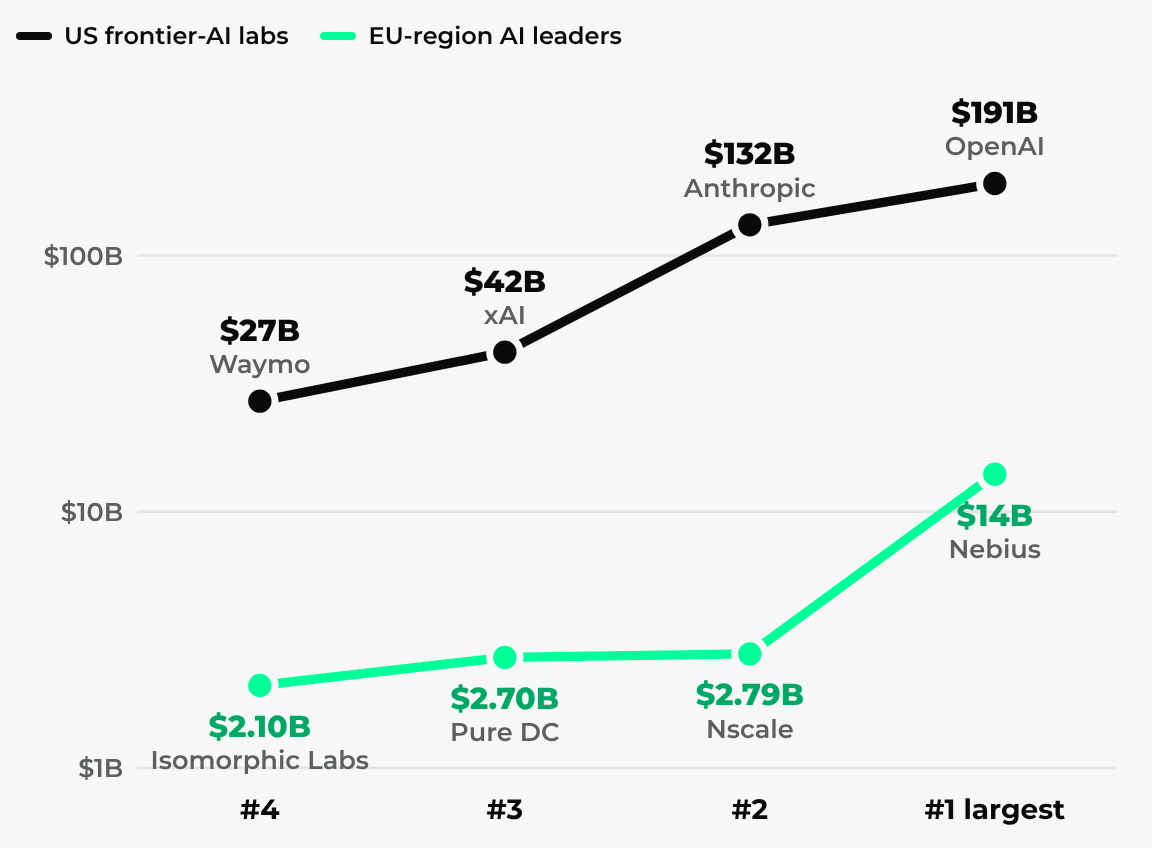
↗ 01 European Venture Capital TrendsEuropean VC activity during the first half of 2026 concentrated in fewer companies and larger funding rounds. European technology companies raised €44.1 billion across more than 1,740 deals in H1 2026, suggesting that investors are becoming more selective in favour of less companies with proven market demand, strong growth potential, and defensible technology. In terms of capital allocation, investors prioritise technology-intensive sectors such as deep tech, native AI and cloud infrastructure. AI has been particularly prominent in H1 2026, with the largest funding rounds dominated by frontier AI labs: the top 4 US AI leaders raised US$392 billion cumulatively (15.2x more than the top 8 EU-region companies' US$25.82 billion). Both the US and the EU registered cca 60–65% of their cumulative totals closed in H1 of 2026 alone. Ranked head-to-head by company (Figure 1), the gap is sharp: the top 4 US labs alone (US$392 billion) have raised roughly 19x more than the top 4 EU-region leaders (US$21.1 billion).
| ||||||||||||||||||||||||||||||||||||||||||||||||||||||||||||||||||||||||||||||||||||||||||||||||||||||||||||||||||||||||||||||||||||||||||||||||||||||||||||||||||||||||||||||||||||||||||||||||||||
|
↗ 02 Moldova's Startup Ecosystem TodayAcross Europe, Moldova has strengthened its position as one of the region's emerging startup ecosystems. According to the StartupBlink Global Startup Ecosystem Index 2026, Moldova recorded an ecosystem growth rate of 91.9%, the highest in Europe and the third-highest globally, while climbing eight positions to 82nd place worldwide. Although the ecosystem is relatively small, this progress is notable when compared with neighbouring countries such as Romania and Ukraine, as well as other startup ecosystems in Central and Eastern Europe. Moldova has the highest number of startups per capita among its neighbours, with approximately 102 startups per million inhabitants, more than Romania (90) and Ukraine (68), as well as regional peers Bulgaria (82) and Poland (50). The country has currently more than 400 technology startups, with 320 already included in the Startup Moldova database, representing approximately 20% year-on-year growth and around 1.3% of all startups in Eastern Europe. Moldova's recent progress is driven not only by an increase in the number of startups, but also by a high concentration of entrepreneurial activity relative to its population.
Note: the density figure above and the ecosystem's total company count are drawn from different methodologies — the StartupBlink Index applies its own inclusion criteria for cross-country comparison, while the Startup Moldova database uses broader domestic tracking criteria. The two are not directly reconcilable on a single company count, and both are reported here for completeness rather than treated as a single consistent figure. The economic footprint of the ecosystem has also increased. In 2025, Moldovan startups generated more than US$60 million in revenue and created over 1,500 jobs, while total investment increased from approximately US$7.9 million in 2024 to US$17 million in 2025. It is more than 2X year on year. 37 startups attracted investment during 2025, including 15 companies that secured follow-on rounds. The ecosystem also recorded two exits: Planable and Parkopedia providing further evidence of increasing ecosystem maturity. Planable, a social media collaboration and management platform, was acquired by SE Ranking. Parkopedia, a provider of parking, EV charging and connected-car data solutions, was acquired by EasyPark Group. Chisinau remains the country's main innovation hub and concentrates the majority of startup activity. While Moldova is considerably smaller than established CEE ecosystems such as Poland and Romania, the key challenge is shifting from startup creation toward the ability of companies to attract follow-on capital and scale internationally. | ||||||||||||||||||||||||||||||||||||||||||||||||||||||||||||||||||||||||||||||||||||||||||||||||||||||||||||||||||||||||||||||||||||||||||||||||||||||||||||||||||||||||||||||||||||||||||||||||||||
|
↗ 03 H1 2026 Investment AnalysisIn the first half of 2026, 49 startups attracted a combined US$4.4 million in investment. Funding was provided through a mix of venture capital, angel investment, accelerator and pre-accelerator programmes, development organisations and other early-stage financing instruments. Investment activity was concentrated at the early stage of company development: 48 of the 49 companies (98.0%) were pre-seed. In terms of funding history, 41 startups (83.7%) received their first investment round, while eight (16.3%) secured follow-on funding. The sections below examine how H1 2026 investment was distributed across time, sectors, funding stage and founder characteristics.
In just six months, deal count (49) already exceeds all of FY2025 (37) which is a positive signal for company creation. But the average investment per startup fell from US$459K in FY2025 to US$90K in H1 2026. Unlike in the EU and US, where money is going into fewer and bigger deals, investors here still put small checks into more startups.
In H1 2026, Moldova attracted cca €1.59 per resident, based on the analysed investment volume and an official population of 2.37 million residents as of 1 January 2026. Romania attracted €8.93 per resident (€170 million investment raised); Lithuanian startups raised €28.95 per resident (€83.6 million investments raised); and Ukraine raised €6.29 per resident (€245.2 million investment raised). Ukraine's result is particularly notable given the ongoing war, and shows that the country continues to attract significant startup investment, especially in technology sectors. Among neighbours ranking first is Romania, second Ukraine and third Moldova. Even though we have a strong startup activity, the amount of capital attracted per resident is still insignificant compared to neighbors and regions.
Per-capita figures are informative, but they blend two things together: how much capital an ecosystem attracts, and how large the economy is to begin with. Adjusting startup investment for GDP isolates the first. Using 2025 nominal GDP: Moldova (~€17.5 billion), Romania (~€368.9 billion), Lithuania (~€81.8 billion) and Ukraine (~€183.6 billion), H1 2026 startup investment represents cca €214 per €1 million of GDP in Moldova, €461 in Romania, €1,022 in Lithuania and €1,336 in Ukraine (Figure 5).
The ranking does not change, Moldova still lags behind all three peers. On a per-capita basis, Lithuania raises 18x more than Moldova; adjusted for the size of each economy, that gap narrows to about 5x, because Lithuania is also a wealthier country (GDP per capita of approximately €28,300, versus Moldova's €7,400). Moldova's shortfall is therefore not explained by the lower income level alone: even relative to the size of its own economy, Moldova invests less in its startup ecosystem than each of its regional peers. Moldova's high startup density proves again that the main challenge goes beyond the number of startups in the ecosystem. With 102 startups per million residents, Moldova already performs strongly (Figure 2). The gap between startup density and capital raised, on both a per-capita and a GDP-adjusted basis, points out the biggest problem: a financing gap. Attracting more private capital to support startups progress is a priority for the ecosystem. It will help startups grow past pre-seed and reach later stages especially for their go-to-market activities.
Enterprise Software represents the largest sector in H1 2026, accounting for 22.4% of funded startups (11 of 49). DeepTech, FoodTech, FinTech and EdTech each account for 6.1% of the sample, with three startups in each category, and PropTech represents 4.1% (2 startups). The remaining 49% is spread across a wide range of other sectors, including Marketplace, Mobility, MediaTech, LogisticsTech, BeautyTech, HealthTech and CyberTech.
Moldova’s early-stage ecosystem is predominantly SaaS-driven. Enterprise Software accounts for the largest share of deals, which shows that most startups in the ecosystem build software products. HealthTech, AgTech, DeepTech and other sectors are also represented, though they are less.
The funding-stage distribution of the ecosystem shows that it is highly concentrated at the pre-seed level: of the 49 funded startups, 48 (98.0%) pre-seed, while only one (2.0%) is at Seed stage. In terms of funding history, 41 startups (83.7%) received their first investment round, while eight (16.3%) secured follow-on funding.
Follow-on investment is a positive sign, showing that some companies manage to raise again as they grow. Still, a high share of pre-seed companies points to the key challenge for the ecosystem: helping more startups move past the earliest stage and reach Seed, Series A and later rounds.
Moldovan-registered startups account for 89.8% of funded companies (44 of 49), while internationally registered companies represent the remaining 10.2%. These include two companies registered in Denmark and one each in the United States, Romania and France. Therefore, Moldovan startups operate internationally early in their startup journey. Regarding gender representation in H1 2026, 6 of the 49 funded startups have a female founder or co-founder (12.2%). Together, these companies attracted approximately US$125,780, or around 2.9% of the total investment recorded in the dataset. At European level, startups with at least one woman founder attracted US$5.1 billion in H1 2026 (11.2%) of total European venture capital, up with 3.2% compared to 2016. This gradual progress over time is a positive sign, however women-founded companies still receive a relatively small share of overall VC funding. Given the small Moldovan sample, these figures should be treated as an area to monitor rather than as evidence of a long-term trend. | ||||||||||||||||||||||||||||||||||||||||||||||||||||||||||||||||||||||||||||||||||||||||||||||||||||||||||||||||||||||||||||||||||||||||||||||||||||||||||||||||||||||||||||||||||||||||||||||||||||
|
↗ 04 Conclusion, H2 2026 Outlook and RecommendationsOverall, Moldova has a wide startup activity, but almost all of it is still at the earliest stage. Of the 49 startups funded in H1 2026, 48 raised pre-seed and only one raised Seed. Eight companies (16.3%) raised a follow-on round. That makes follow-on funding the most important number to watch. Moldova already creates a lot of startups, and the next challenge is helping more of them grow from pre-seed to Seed and beyond. More second and third rounds would show that startups are growing, keeping investors interested, and getting ready to expand abroad, not just being founded. Moldova's growing international ties were also clear at Startup Moldova Summit 2026. The event brought together more than 2,000 participants, over 60 international speakers and 150 startups from Moldova and the region. It connected startups with VC funds and angel investors, and it hosted delegations from Sweden, Romania and Ukraine. Connections like these can help Moldovan startups reach international investors and raise bigger rounds, but only if someone actively turns them into follow-on funding rather than leaving it to chance. Based on the H1 2026 evidence, we see three priorities for the second half of the year:
| ||||||||||||||||||||||||||||||||||||||||||||||||||||||||||||||||||||||||||||||||||||||||||||||||||||||||||||||||||||||||||||||||||||||||||||||||||||||||||||||||||||||||||||||||||||||||||||||||||||

Leave your email to subscribe to our newsletters *
By subscribing you agree with our Privacy Policy
© 2024 Startup Moldova Foundation. All rights reserved.
